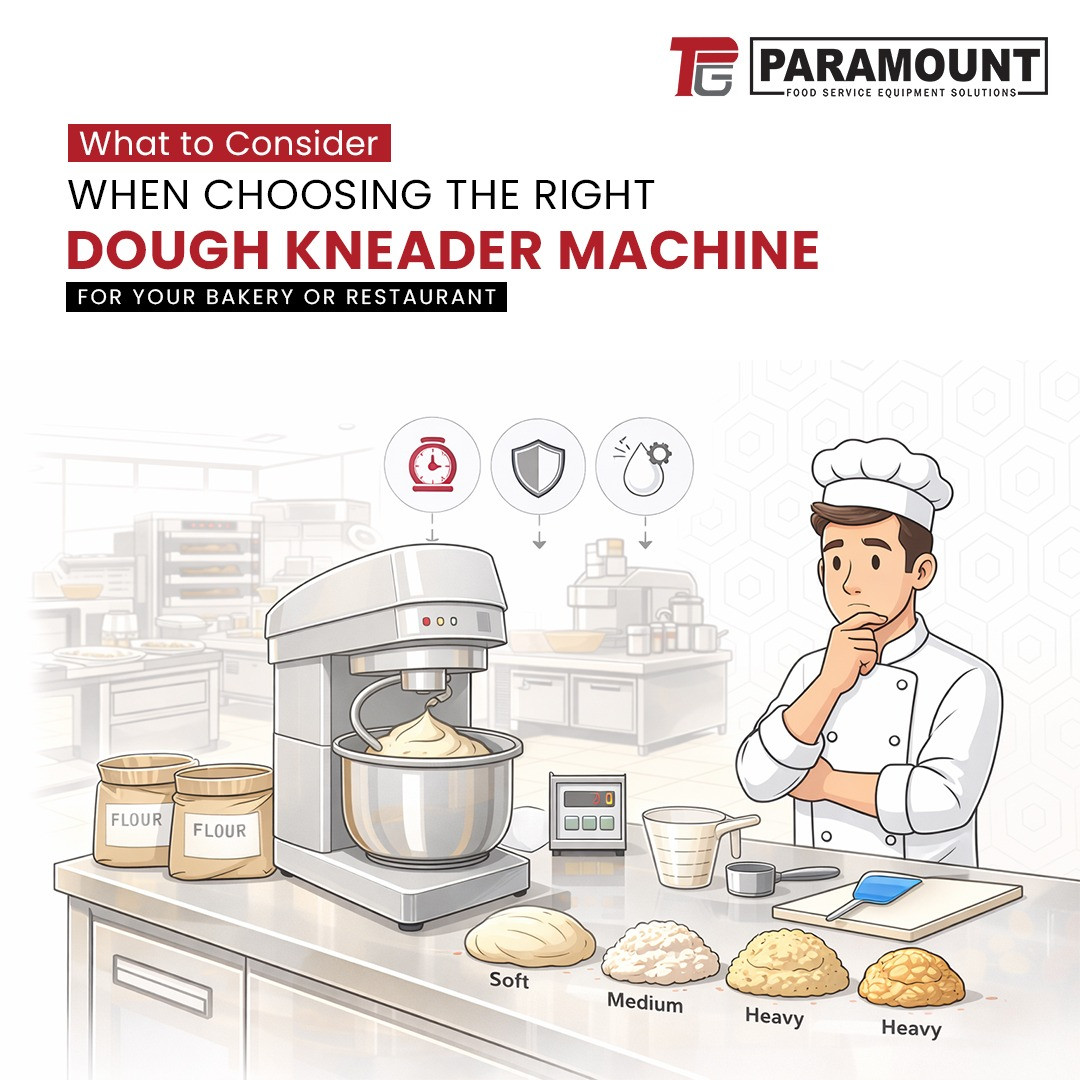
What to Consider When Choosing the Right Dough Kneader Machine for Your Bakery or Restaurant🏭🍞
By paramount
Running a bakery or restaurant requires precision, speed, and consistency — and at the center of every great kitchen operation is the right dough kneader machine. Dough forms the base of countless products: bread, pizza, buns, chapati, pastries, doughnuts, croissants, and more. When your dough quality is perfect, your entire menu performs better. That is why choosing the right kneader is not just an equipment decision, it is a business decision that directly influences customer satisfaction, product quality, staff efficiency, and long-term profitability.🍞⚙️
A high-performing kneader ensures uniform mixing, maintains dough elasticity, saves preparation time, and reduces manual strain on your staff. Whether your outlet produces small batches daily or handles large commercial volumes, the right machine can transform your kitchen into a streamlined, productive, and hygienic workspace.⏱️
This detailed guide explains what you should consider before selecting the ideal dough kneader and how the right choice supports your bakery or restaurant. At Paramount Food Service Equipment Solutions, with branches across the UAE, Qatar, Oman, Bahrain, and India, you can find a wide range of professional dough kneader machines designed to meet the needs of every foodservice business.🏭👨🍳
Key Factors to Consider Before Buying a Dough Kneading Machine
1. Capacity & Bowl Size - Your dough production volume should guide your choice. Small kitchens or home bakers may prefer a dough kneading machine for home, while bakeries need larger capacities that can handle continuous batches without overheating.
2. Motor Power & Durability - For restaurants with high daily output, a heavy-duty dough mixer machine ensures long-term reliability. Stronger motors improve kneading consistency, even with stiff doughs like chapati or pizza dough.
3. Kneading Mechanism
Different models offer:
- Spiral mixers
- Planetary mixers
- Tilting head models
Each brings a different kneading style suitable for breads, pastries, chapati, and more.
4. Speed Settings & Controls - Multiple speeds allow better control over gluten development and dough elasticity—critical for both soft and firm doughs.
5. Material & Build Quality - Choose stainless steel bowls, food-grade components, and sturdy frames. Commercial kitchens in the GCC particularly benefit from corrosion-resistant bodies.
6. Safety Features - Overload protection, bowl locks, and auto shut-off features ensure safety during heavy operation hours.
7. Maintenance & Cleaning - Hygiene is crucial. Look for machines designed with detachable bowls, smooth surfaces, and accessible parts for quick cleaning.
Types of Dough Kneaders
Understanding the different types of dough kneaders helps you choose the right equipment for your bakery or restaurant. Each machine is designed for specific dough textures, hydration levels, and production requirements. Selecting the correct model ensures consistent results and smoother kitchen operations.📊🍽️
Planetary Mixers
Planetary mixers feature an agitator that rotates on an offset shaft inside a stationary bowl, mimicking a planet orbiting the sun. Their interchangeable attachments — including dough hooks, beaters, and whisks — make them suitable for mixing pastries, creams, and lighter doughs. Their versatility allows bakeries to prepare multiple recipes using a single machine.🌍🥮
Spiral Mixers
Spiral mixers are ideal for heavier, low-hydration doughs like pizza, bagels, and artisan breads. These machines keep the spiral hook stationary while the bowl rotates, reducing friction and preventing excessive dough heating. They support small and large batch mixing, making them a preferred choice for bakeries that specialize in bread production.🍕🔥
Fork / Diving Arm Mixers
Fork or diving arm mixers mimic traditional hand-kneading movements. They gently stretch and fold dough using two rotating arms, generating minimal heat. This design preserves dough structure, making these mixers suitable for high-hydration doughs, soft breads, and delicate pastries. 🥐
Dough Maker Machine Capacity
Capacity determines how much dough you can prepare per batch, and it is one of the most important factors when selecting your machine. Smaller kitchens and cafés may find a 10–20 litre mixer sufficient for daily use, whereas medium to large bakeries may require 30–60 litre machines for efficient production. Choosing a capacity that matches your daily dough output ensures smooth workflow and prevents overloading the machine. A well-sized dough maker also improves dough texture and maintains machine longevity. For startups or cafés searching for an affordable dough mixer, selecting the right capacity is essential. 📈🏪
Matching Dough Type and Hydration
Size and Space of Dough Mixer Machine
Every kitchen has unique spatial constraints, so the machine you choose must fit comfortably into your working area. Compact table-top models are suitable for small bakeries or home-style setups, while floor-standing mixers with larger capacities are better for commercial operations. Evaluating your kitchen workflow and available counter or floor space helps ensure that the dough mixer integrates seamlessly into your production line without interrupting movement or efficiency.
Mixing Speed and Control Evaluation
Consider Quality and Durability
Budget and Cost
Why Choose Paramount Food Service Equipment Solutions?